
News about the start of Ukrainian ballistics testing is perceived as a true ray of hope. Especially now, when Ukrainian cities suffer round-the-clock from endless attacks by Russian Shaheds, missiles, and drones, and people long to feel that Ukraine has the means to deliver a symmetrical response to the enemy.
When reports appear about new Ukrainian missiles capable of striking hundreds of kilometers away, a feeling naturally arises: perhaps a weapon is finally emerging that will allow Ukraine not only to defend itself, but also to pose a real threat to Russia on its own territory.
Formally, Fire Point is adhering to its announced schedule. The first test launches of a ballistic missile have already taken place. Earlier, Fire Point’s chief designer, Denys Shtilerman, predicted that by late summer or early autumn, the company would move on to test flights targeting objectives inside Russia.
“I expect that this summer, early autumn at the latest, we will begin test flights toward Moscow… As soon as a test flight demonstrates that everything operates as planned, the subsequent test flights should already head there, to Moscow,” Shtilerman stated in an interview.
The President of Ukraine also previously spoke publicly about the imminent readiness of Ukrainian ballistics.
However, it is worth pausing here.
Between a successful test launch and the emergence of a weapon capable of systematically shifting the battlefield situation, there lies an enormous gulf.
A first test flight is merely the beginning of a long and extraordinarily complex journey. A missile must do more than just launch. It must operate reliably, strike targets accurately, be mass-produced, and—equally importantly—be produced in quantities sufficient for real military application.
It is precisely at the transition from isolated tests to mass employment that a series of serious questions arises:
Is Fire Point capable of scaling production?
Has the rocket fuel issue been resolved?
How accurate will Ukrainian ballistics be?
And most importantly – will these advertised capabilities translate into genuine combat capability?
Caveat 1. Scale and Quantity
One of the sharpest questions surrounding Fire Point is not whether they managed to launch a missile once.
The question lies elsewhere: how many can realistically be produced tomorrow, next month, and in six months?
This is precisely where the starkest gap between project presentations and real-world industrial manufacturing begins.
Among Ukrainian experts, serious doubts are already being voiced regarding Fire Point’s ability to rapidly achieve large-scale mass production. Military experts Serhiy Zghurets and Valeriy Romanenko expressed their skepticism in comments for DW.
“A promise is one thing, but actual program execution is another. You can see for yourself: the Flamingo missile, which was promised to be produced at a rate of three units a day starting from the beginning of the year, is currently being produced at a rate of three units a month,” notes aviation expert Valeriy Romanenko.
A similar view is held by the director of Defense Express, Serhiy Zghurets:
“I am alarmed by teams that simultaneously take on multiple areas, as Fire Point is demonstrating. They are making drones, anti-ballistic systems, and ballistic missiles. This diminishes the ability to concentrate on a single project.”
Military expert Viktor Kevliuk urges people not to expect miracles from Fire Point:
“Personally, I do not believe that a company without rocket industry specialists on staff is capable of manufacturing missiles. Saying that we have 23 launches today and will have 1,000 in September is simply not how things work. Let’s stay closer to reality.”
The gap between announced and actual production rates is not a uniquely Ukrainian problem, but a systemic feature of any missile program born under the pressure of wartime.
Serial production of missile technology is not like assembling a drone from commercial off-the-shelf components. It is a chain comprising dozens of enterprises: manufacturers of airframes, guidance systems, engines, electronics, and propellant. Any single link in this chain can become a bottleneck, and scaling “on paper” rarely corresponds smoothly to scaling in practice.
History shows that even states with decades of established missile industry experience (such as Iran or North Korea, which also developed programs under sanctions) took years to reach declared production rates, lagging significantly behind initial timelines. Meanwhile, Fire Point claims far shorter deadlines, aiming to break nearly every global record. But will they succeed?
Caveat 2. Technical Components and Fuel
There is another topic that is mentioned far less often in flashy presentations, yet without it, a missile simply cannot become a mass-produced weapon.
Serhiy Zghurets highlights the creation of solid rocket fuel as one of the key problems of the Ukrainian missile program:
“One of the urgent problems that has not been fully resolved by the Ukrainian side is the creation of rocket fuel. This was achieved neither by Yuzhnoye Design Office in its work with the Pavlohrad Chemical Plant on the Sapsan project, nor by Fire Point.”
The company plans to build a solid rocket fuel plant in Denmark. Initially, Fire Point estimated the project cost at approximately €50 million. Later, that figure roughly tripled—to €150 million. However, the plant has still not been built.

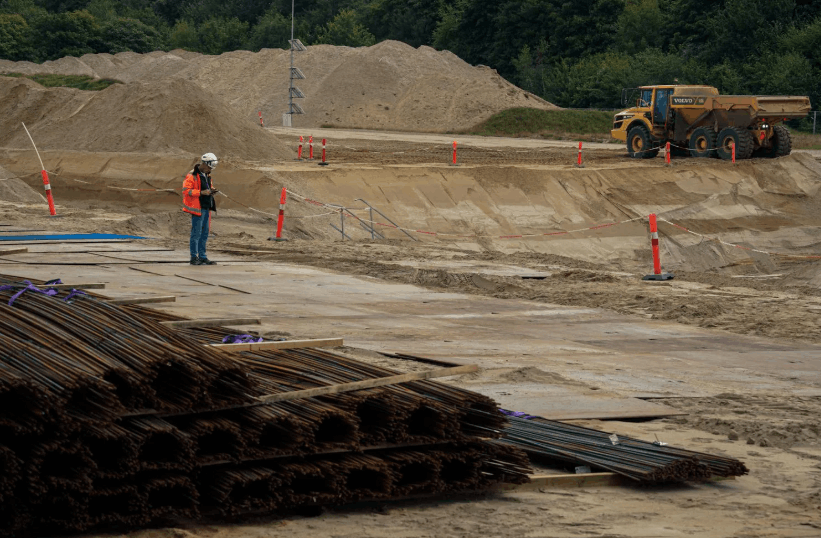
The plant’s launch timeline has also shifted. According to recent reports, the facility is now expected to become operational in 2027. At the same time, as seen in the photos above—published in August of this year—construction remains at an initial stage.
This raises an uncomfortable question: how exactly does Fire Point plan to scale the production of ballistic missiles prior to the full launch of its own propellant plant?
Incidentally, Shtilerman himself remarked in a private conversation with Yuriy Kasyanov that a propellant plant is not particularly difficult to build. However, these words should be viewed critically: constructing such a facility is, in reality, far from easy, if only because solid rocket propellant plants are critically scarce across Europe—domestic production on the continent is virtually non-existent, and existing capacities largely depend on suppliers from the United States and China. Denmark agreed to host this manufacturing on its territory precisely because of this deficit; for the country, it is not merely a service to Ukraine, but a means of acquiring a capability it currently lacks. In other words, building such a plant is a rather unique undertaking.
Caveat 3. Guidance Accuracy
There is another factor that is easy to lose sight of behind impressive range figures.
A missile may have a range of hundreds of kilometers, but what happens when it reaches its destination?
Accuracy.
Viktor Kevliuk emphasizes that one should not confuse long-range drone technology with ballistic missiles:
“From a technological standpoint, creating a ballistic missile is not inherently unattainable for Ukraine. However, the main difficulty lies in ensuring accuracy. It is not enough to make the missile fly; it is far more challenging to ensure it hits the target.”
Fire Point’s loud announcements and promotional campaigns serve their purpose—exerting psychological pressure on the adversary and demonstrating potential to allies. However, one would hope that this deterrence relies not just on promotional videos, but is backed by real, verified results. Until then, the expert community remains cautious, urging a more grounded evaluation of the program—“closer to reality.”
At the same time, it is important to recognize the primary obstacle in evaluating the effectiveness of this program: the public and independent analysts will, in all likelihood, never learn the real usage statistics of these missiles or whether they reach their targets at all. For obvious wartime reasons, details of launches and successful hit rates will remain strictly classified.
Yet another critical issue arises here: public reports linking Fire Point to Tymur Mindich and circles close to the authorities create a risk of political bias. Under conditions of complete data opacity, there is a danger that the government may have a direct interest in concealing discouraging statistics to cover up the inefficiency of projects that receive state resources and a green light at the highest levels.